🇿🇦 South Africa · Sotho · 7 min read
The Three Sotho Brothers
Unity outlasts cleverness alone
Cultural Background
Cattle are the measure of wealth, marriage and honour among the Basotho, and stories of lost or stolen herds carried real weight for listeners who understood that a family's cattle represented generations of labour and lobola arrangements yet to come. The Basotho highlands themselves — cold, steep, and dotted with sandstone caves — are the setting for many tales in which travellers must survive the mountain's tests, often guided by a wise old stranger who is later revealed to be more than human. This story belongs to a well-loved pattern across Sotho oral tradition, in which siblings sent on the same task fail or succeed according to whether they remember that the family's fortunes were never meant to be carried by one pair of hands alone.
The Moonlight Story
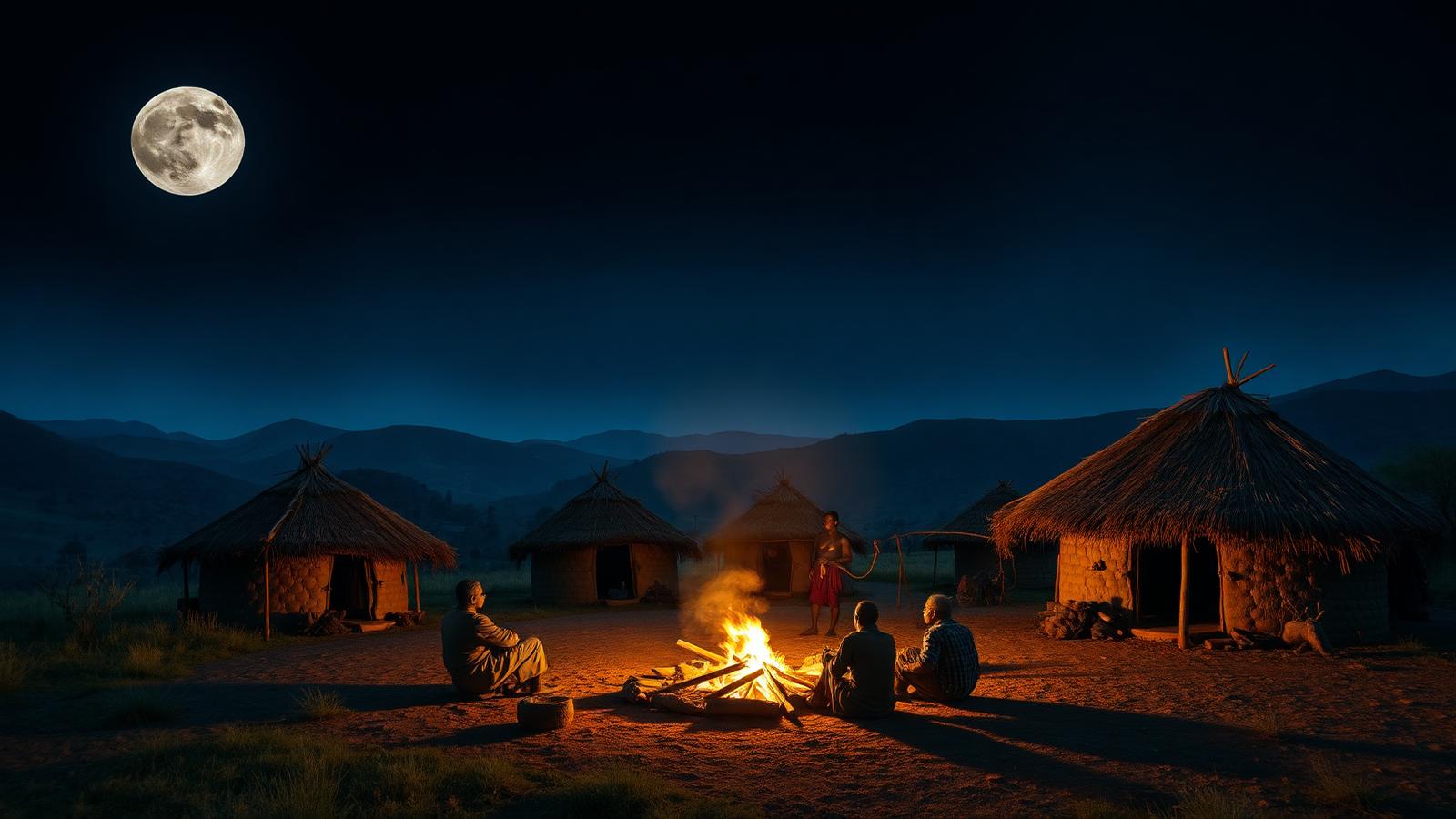
In the Maloti mountains, where the mist sits on the peaks like a blanket a giant forgot to fold away, there lived a widow named 'Mamokete with three sons. Her husband had left her a herd of fine cattle before he died, and that herd was the only wealth standing between the family and hunger, the only bride-price that would one day bring daughters-in-law into the home, the only inheritance her sons would carry into their own lives.
One winter night, thieves came down from the high passes and drove the entire herd away into the mountains. 'Mamokete woke to an empty kraal and cried out so loudly that her three sons came running from their sleeping hut.
"Our cattle," she wept. "Everything your father left us. Gone into the mountains."
The eldest son, Thabo, was known throughout the village for his strength — he could lift a full-grown ox onto his shoulders and had once wrestled a leopard away from a goat pen with his bare hands. "Do not weep, Mother," he said. "I will bring the cattle back myself. What thief can stand against these arms?" And he strode off into the mountains alone, refusing his brothers' company, certain that strength needed no help.
The second son, Lefa, was known for his cleverness — he could solve any riddle brought before the village elders and had once talked his way out of a debt owed to a Free State trader twice his age. "Do not weep, Mother," he said. "I will outwit these thieves with words alone." And he too went into the mountains by himself, certain that cleverness needed no help.
The youngest son, Tsepo, was neither the strongest nor the sharpest-tongued. He was known mostly for his gentleness — he was the one who nursed injured birds back to flight and shared his own porridge with hungry travellers passing through. His mother did not expect much of him, and even he did not expect much of himself, but he took his walking stick and a small bag of dried mabele and followed the path his brothers had taken, some distance behind.
Thabo climbed for two days until he found the thieves' camp in a high rocky valley, guarded by three enormous dogs with teeth like white thorns. He roared his challenge and charged in, certain his strength would scatter them. But the dogs were many and hungry, and though Thabo fought bravely, he was soon overpowered, bitten, and thrown into a deep stone pit the thieves used to hold captured game, where he sat bruised and furious with no way to climb out.
Lefa arrived at the same valley a day later, saw the dogs, and thought quickly. He approached the thief camp with honeyed words, claiming to be a lost trader offering fine blankets in exchange for shelter. The thieves, who were cleverer than Lefa expected, saw through his story within the hour, took his blankets anyway, and threw him into the same pit as his brother, laughing at how easily his tongue had betrayed him.
When Tsepo finally reached the valley, he did not see his brothers anywhere, but he heard low groaning coming from beneath a pile of thorn branches covering a stone pit. He crept close and found Thabo and Lefa, bruised and ashamed, staring up at him.
"Little brother," Thabo whispered, "go back. There is nothing you alone can do here that we could not."
But Tsepo did not go back. He sat at the edge of the pit and thought. He had neither Thabo's strength nor Lefa's cleverness, but he remembered something their mother often said: that even a small stick, added to others, can hold up a roof that would collapse on one stick alone.
That night, while the thieves slept off their palm beer around the fire, Tsepo did not try to fight the dogs or outwit the men. Instead, he quietly shared his dried mabele with the dogs one by one, speaking softly to them the way he spoke to injured birds, until the great beasts — who had never in their lives been fed gently instead of beaten into obedience — lay down beside him and let him pass unharmed. He found a long, sturdy branch, lowered it into the pit, and pulled his brothers out one at a time, bracing his weight against a boulder so the branch would not slip.
Once free, the three brothers did not celebrate too loudly. Instead they sat together in the dark and finally spoke as equals. Thabo admitted that his strength alone had only earned him a beating. Lefa admitted that his clever tongue alone had only earned him laughter. And together, combining Thabo's strength to hold the gate, Lefa's cleverness to time their approach when the thieves' watch changed, and Tsepo's gentleness to keep the dogs calm and quiet, the three brothers drove the entire herd of cattle silently out of the valley before the thieves woke, and walked them home over three days of mountain paths, taking turns to rest and to walk, sharing the last of the dried mabele equally between them.
When they came down into the valley where their mother lived, driving the cattle before them, 'Mamokete wept again — this time with joy — and asked which of her sons had saved the herd.
"All three of us," said Thabo, "though none of us could have done it as one."
From that day, whenever a hard task faced the family, 'Mamokete would remind her sons of the mountain, and later, her sons would remind their own children, until the story became one that every Sotho child learned before they were old enough to herd cattle themselves: a single hand cannot tie a bundle, but three hands, working together, can carry home an entire herd.
Moral Lessons
What the Story Teaches
- For children
- Your gift alone might not be enough, and that is all right — it becomes enough when you share it with others who have different gifts.
- For adults
- Pride in our own strength or cleverness can blind us to how much easier a task becomes with honest partnership.
- For leadership
- A leader who insists on solving everything alone, whether through force or cunning, will eventually need someone gentler to pull them out of the pit they dug.
- For business
- Teams that combine different strengths — force, strategy, and empathy — outperform brilliant individuals working in isolation.
- For family
- Siblings are often each given a different gift precisely so that, together, they can do what none of them could do alone.
- For community
- A community's strength lies not in its most powerful or cleverest member, but in how well its different gifts are woven together.
Discussion Questions
For the Family or Classroom
- Why did Thabo and Lefa both fail when they relied only on their own gift?
- What allowed Tsepo to succeed where his stronger, cleverer brothers had failed?
- Why do you think the story chooses gentleness, rather than another strength, to be the quality that unlocks success?
- What does the mother's saying about a single stick and a bundle of sticks mean in your own words?
- Have you ever seen a team fail because each person tried to solve a problem alone?
- What different 'gifts' exist among your own family or friends, and how could they work together on a shared goal?
Related Proverbs
"Motho ke motho ka batho."
"Kgomo ya moshemane ga e etswe ke ngwana a le mong."
"Lerumo le lengwe ha le bolaee tau."
Characters
Thabo
Eldest brother
Physically powerful, proud, initially unwilling to accept help
Symbolism: Strength without humility
Lefa
Second brother
Sharp-tongued, confident, quick to rely on cunning alone
Symbolism: Cleverness without partnership
Tsepo
Youngest brother
Gentle, patient, underestimated by his family
Symbolism: Quiet strength and the power of empathy
'Mamokete
Mother of the three brothers
Devoted, wise, source of the family's guiding proverb
Symbolism: Ancestral wisdom passed through generations
Vocabulary
Mabele
mah-BEH-leh · Sotho / Southern African Bantu languages
Sorghum, a staple grain porridge
Kraal
krahl · Afrikaans, used widely across Southern African cultures
An enclosure for livestock, also a homestead
Lobola
loh-BOH-lah · Nguni and Sotho-Tswana cultures
Bride-price, traditionally paid in cattle, sealing a marriage between families
Basotho
bah-SOO-too · Sesotho
The Sotho people
Watch
Animated story film coming soon.
Listen
Narrated audio coming soon.
Music
McEncomium song adaptation coming soon.
Teacher Resources
For Classrooms and Homes
Download the full parable as a printable PDF — story, cultural background, moral lessons, discussion questions, proverbs, characters, and vocabulary, all in one handout for the classroom or family read-aloud.
Join the conversation
Village Square
Share your thoughts on this parable, ask questions, and connect with others exploring African stories and wisdom.
Village Voices
What villagers say about "The Three Sotho Brothers"
Loading comments…