🇿🇦 South Africa · Venda · 6 min read
The Stone That Listened
Words have weight
Cultural Background
The Venda people of Limpopo hold rivers and pools in deep reverence, none more so than the mysterious Lake Fundudzi, believed to be home to Zwidutwane, the water spirits, and guarded from casual disturbance. Speech itself carries spiritual weight in Venda tradition, where elders are addressed with careful, indirect language as a mark of respect, and children are taught early that careless words can wound as surely as a blow. This story reflects that worldview: a physical object — a stone — is used to make an invisible habit visible, a teaching method common across many African oral traditions, where wisdom is planted in a game or a ritual so that children absorb the lesson through their own hands before they ever hear it explained in words.
The Moonlight Story
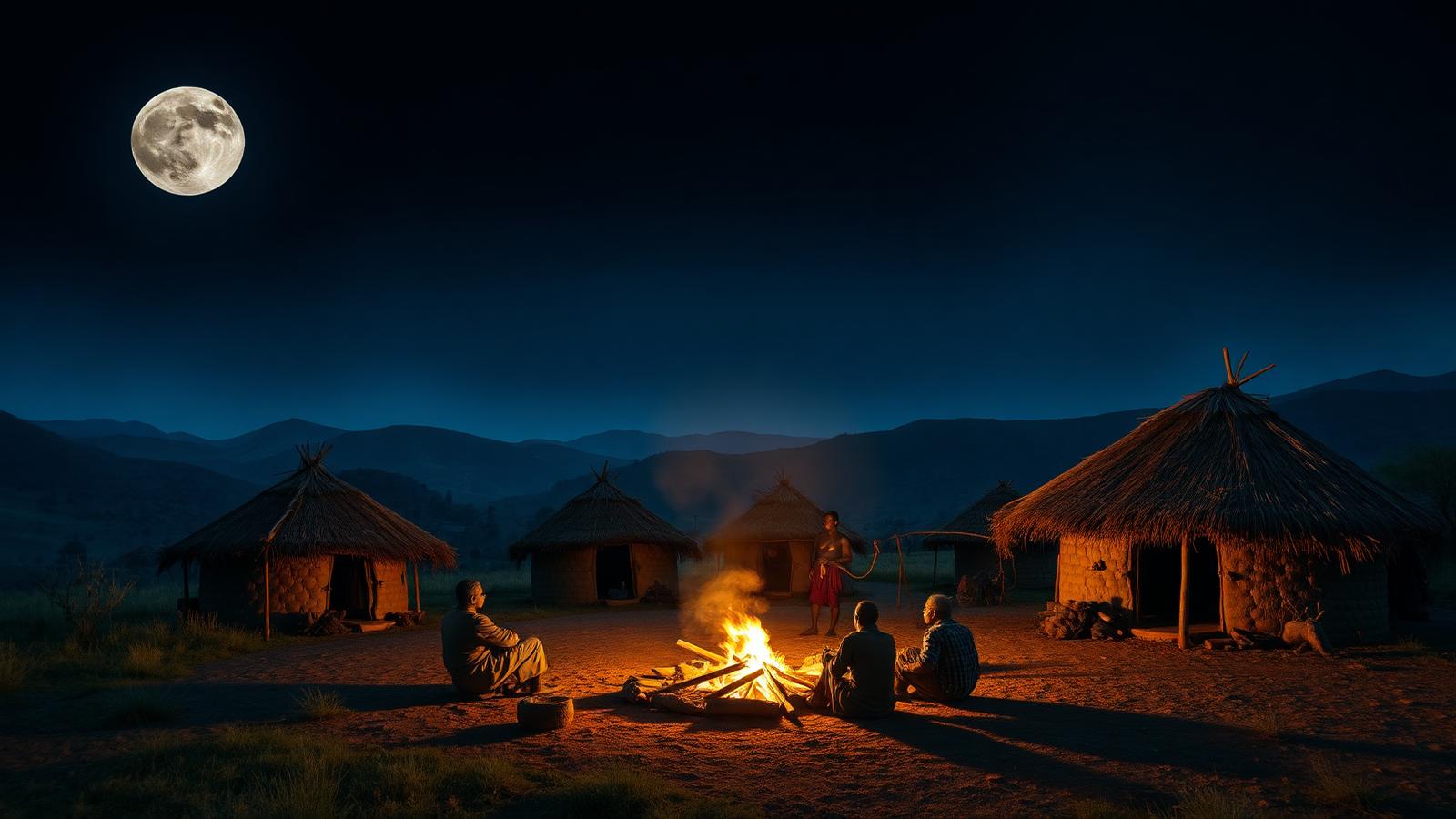
In a village at the foot of the Soutpansberg mountains, where the Venda people have lived among baobabs and sacred forests for longer than anyone could count, there lived an old man named Vho-Mudau, who was known for saying very little and being listened to very closely whenever he did speak.
Vho-Mudau had six grandchildren, and that year, as the dry season set in and tempers grew short around the household, he noticed that his grandchildren had begun to speak to one another the way stones are thrown — carelessly, without weighing whether they would hurt. The eldest girl mocked her younger brother's stutter until he stopped speaking altogether at meals. Two boys traded insults over a game of morabaraba until one struck the other. Even the gentlest of the grandchildren, a quiet girl named Khathu, had taken to muttering unkind things under her breath when she thought no elder could hear.
One evening, Vho-Mudau called all six children to sit with him beneath the big marula tree at the edge of the homestead. In his lap he held six small, smooth river stones, each one worn round by years of water.
"I am going to give each of you a stone," he said, placing one in each child's palm. "From tomorrow until the first rains of the new season, every time you speak a careless word — a word meant to wound, to mock, or to shame another person — you will walk to the river and drop your stone into the water. Then you must come back to me and tell me honestly that you have done it."
The children looked at their stones, unimpressed. "That is all?" asked the eldest, Nyeleti. "Just drop a stone?"
"That is all," said Vho-Mudau, "and that is also everything. Try it, and tell me at the end of the season what you have learned."
The children agreed, mostly to please their grandfather, and thought little more of it. But the very next morning, Nyeleti snapped at her younger brother for spilling porridge, calling him clumsy and stupid in front of the whole family. She remembered the stone in her pocket and, feeling foolish, walked the long path down to the river and dropped it in, watching it sink into the brown water with a small, unsatisfying plop.
That evening she asked her grandfather for a new stone, since hers was gone, and he gave her one — but only one, and only after she told him honestly what unkind word had sent her to the river.
By the third week, something curious had begun happening in the household. The children noticed that walking to the river took time — nearly half an hour there and back — and that admitting to their grandfather exactly what they had said was far more uncomfortable than the insult itself had been to speak. Khathu found herself biting back a sharp remark about her cousin's poor herding one afternoon, not because she no longer felt irritated, but because she pictured herself explaining to Vho-Mudau, out loud, exactly what she had said and why, and the thought of that conversation made the words shrivel in her mouth before they escaped.
One of the twin boys, Mulalo, tried to cheat the game at first, whispering his insults so quietly that no elder could possibly overhear, reasoning that if no one caught him, he owed the river nothing. But his brother Murunwa always seemed to know anyway — not because he had heard, but because he had learned to read the flicker of shame crossing Mulalo's face the instant the words left his mouth. "You know you must go to the river," Murunwa would say quietly, and eventually Mulalo went, less because he feared being caught and more because carrying an unconfessed unkindness had begun to feel heavier than the walk itself.
By the time the first rains finally broke the dry season, the riverbed near the village had visibly changed — a small, new bank of pale smooth stones had gathered at the bend where the children always threw theirs, a little grey shoal that had not existed months before. The village fisherman noticed it and asked Vho-Mudau what had caused it. The old man only smiled and said, "That is the weight of careless words, brought together in one place so a person may see it. Usually it is scattered invisibly through a house, a marriage, a friendship, and no one ever sees the pile it becomes."
When the season ended, Vho-Mudau gathered his six grandchildren beneath the marula tree once more. "Tell me what you have learned," he said.
Nyeleti spoke first. "I learned that the walk to the river is longer than the walk to a kind word. It is always easier to be patient by the time I reach the water — I only wish I could feel that patience before I open my mouth instead of after."
Khathu said, "I learned that a careless word costs more than a kind one, even though the kind one takes no stone at all."
Mulalo, more quietly than usual, admitted, "I learned that hiding an unkindness does not make it lighter. It only makes it mine to carry alone."
Vho-Mudau nodded slowly at each answer, satisfied. "The river did not change," he said. "You changed, and the river only showed you the shape of what you were already doing. Now, when you feel a careless word rising, you will not need a stone in your pocket to remember its weight. You will feel it in your chest before it ever reaches your tongue."
And it is said that even now, generations later, Venda grandparents who wish to correct a sharp-tongued child do not scold them directly, but simply hand them a smooth stone from the riverbed and ask, softly, whether there is somewhere they need to walk to before speaking again.
Moral Lessons
What the Story Teaches
- For children
- Words you cannot take back still leave a mark, even after the sound of them has faded. Think before you speak, not only after.
- For adults
- The discomfort of confessing an unkind word out loud is often the very thing that teaches us to avoid speaking it in the first place.
- For leadership
- A leader's careless words carry further than they realize, landing on people who may never say anything back. Weigh your words as if everyone were counting them.
- For business
- Harsh words in the workplace accumulate like stones in a riverbed — invisible day to day, but eventually reshaping the whole culture of a team.
- For family
- Small daily unkindnesses within a family are rarely dramatic, but they build a weight over time that a single apology cannot easily undo.
- For community
- A community that makes space to notice and name its careless words, rather than pretending they vanish, grows gentler over time.
Discussion Questions
For the Family or Classroom
- Why do you think Vho-Mudau chose a physical stone instead of simply telling the children to be kinder?
- Why was confessing the unkind word to their grandfather harder for the children than dropping the stone itself?
- What does the pile of stones in the riverbed represent by the end of the story?
- Why did Mulalo eventually stop trying to hide his careless words, even when no one was watching?
- Do you think this method would work in your own home or classroom? Why or why not?
- What is the difference between regretting a word after saying it and weighing a word before saying it?
Related Proverbs
"Lufuno lwo no fhela, lu fhedza muthu."
"Mulomo ndi mulenzhe, u a huvhadza vhathu."
"Zwo ambiwa a zwi tou vhuyelela hafhu."
Characters
Vho-Mudau
Grandfather and village elder
Quiet, observant, teaches through patient demonstration rather than lecture
Symbolism: Ancestral wisdom that shapes character through experience, not scolding
Nyeleti
Eldest grandchild
Quick-tempered but willing to learn
Symbolism: The struggle between impatience and self-discipline
Mulalo
One of the twin grandsons
Prideful, initially avoids accountability
Symbolism: The temptation to hide wrongdoing rather than face it honestly
Khathu
The quiet granddaughter
Gentle but capable of hidden unkindness
Symbolism: The reminder that even quiet people carry careless words
Vocabulary
Vho-
voh · Venda
An honorific prefix used before the name of a respected elder
Morabaraba
moh-rah-bah-RAH-bah · Venda / Sotho-Tswana
A traditional Southern African strategy board game played with stones or seeds
Soutpansberg
SOWT-pahns-berkh · Afrikaans place name, in Venda ancestral territory
A mountain range in Limpopo province, home to much of Venda culture and sacred sites
Zwidutwane
zwee-doot-WAH-neh · Venda
Water spirits believed to inhabit sacred pools such as Lake Fundudzi
Watch
Animated story film coming soon.
Listen
Narrated audio coming soon.
Music
McEncomium song adaptation coming soon.
Teacher Resources
For Classrooms and Homes
Download the full parable as a printable PDF — story, cultural background, moral lessons, discussion questions, proverbs, characters, and vocabulary, all in one handout for the classroom or family read-aloud.
Join the conversation
Village Square
Share your thoughts on this parable, ask questions, and connect with others exploring African stories and wisdom.
Village Voices
What villagers say about "The Stone That Listened"
Loading comments…