🇸🇳 Senegal · Serer · Fulani · 5 min read
The Baobab and the Wind
Roots and resilience
Cultural Background
The baobab holds sacred status across Senegal, particularly among the Serer people, who traditionally buried griots within the hollow trunks of certain baobabs rather than in the ground, believing the tree's spiritual power was strong enough to hold their memory. Both Serer and Fulani communities regard the baobab as a symbol of endurance, community gathering, and ancestral continuity, since a single tree can live for well over a thousand years and provide food, shelter, and shade to generations who never meet one another. The harmattan, the dry dusty wind that sweeps down from the Sahara each year, is a real and formidable seasonal force in Senegal, making the contest between wind and tree in this tale a very literal one as much as a symbolic one.
The Moonlight Story
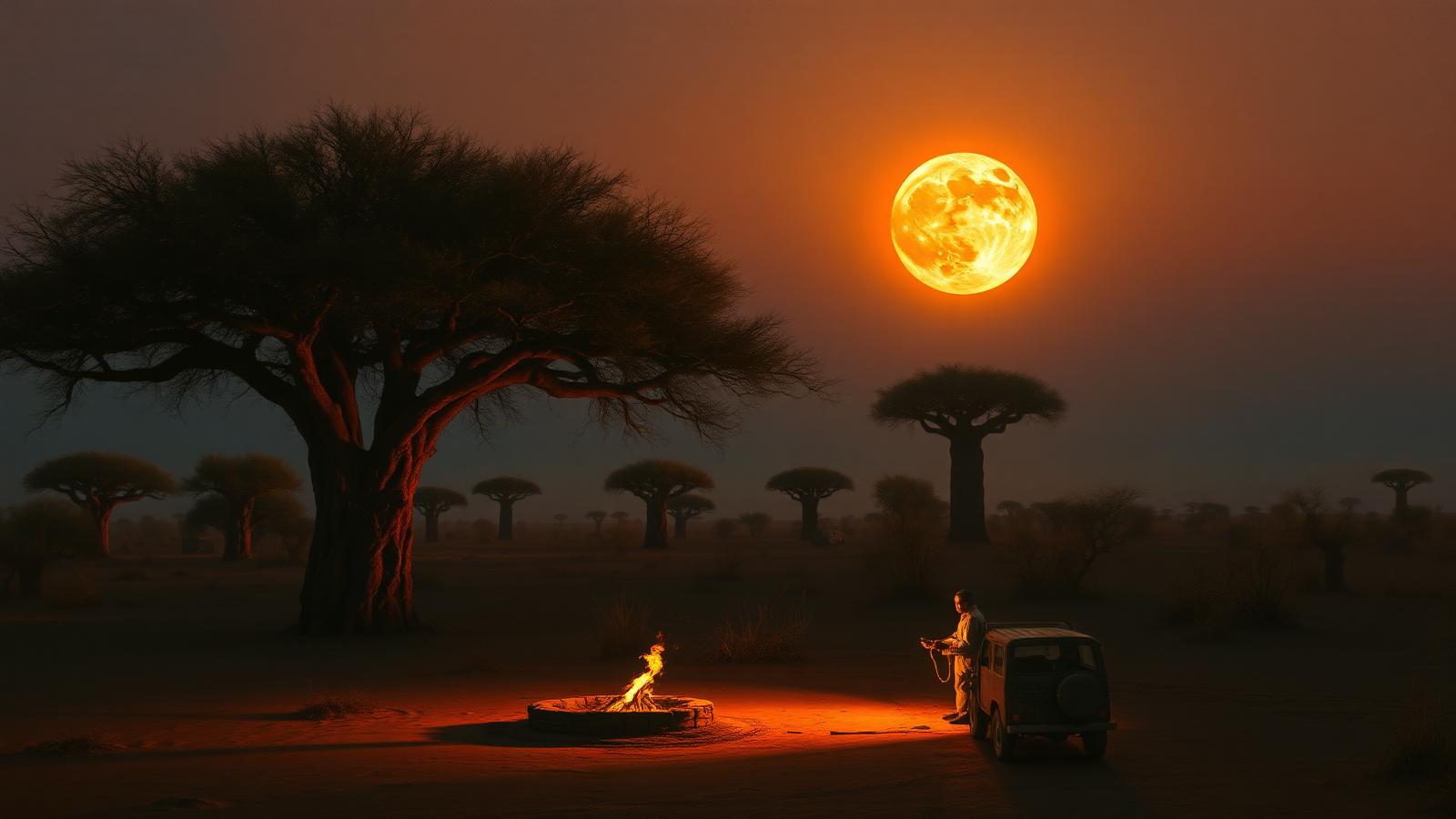
On the edge of the great dry plain where the Sahara sends its breath southward each year, there stood a baobab so old that no living person could say who had planted it, or whether anyone had planted it at all. Its trunk was as wide as a hut, its branches spread like an umbrella turned inside out, and its roots, though no one could see them, reached down and outward further than the tree itself stood tall.
Each year, when the dry season came, the harmattan wind swept down from the desert, carrying with it fine red dust that turned the sky the colour of old copper. The harmattan was proud of its strength — it had stripped the leaves from lesser trees, toppled fences, and sent thatched roofs spinning across whole villages.
'Old tree,' the harmattan howled one dry season, rattling the baobab's few remaining leaves, 'I have watched you standing there for as long as I have made this journey south, growing fat and slow and certain of yourself. This year, I intend to pull you from the earth and scatter you across the plain like I have scattered lesser trees before you.'
The baobab did not tremble, though its highest branches swayed slightly under the wind's assault. 'You may try, harmattan, as you have tried every year I can remember, and every year before that, if the stories the old griots buried within me are to be believed.'
The wind, insulted by the tree's calm, gathered its full strength and threw itself against the baobab with a fury that bent grasses flat for miles around and sent dust so thick into the air that the sun itself dimmed to a dull red coin. It howled through the branches, tore at the bark, and pushed with everything the desert had given it.
The baobab swayed. Its branches groaned. A few dry twigs snapped away and spun off into the red haze. But the trunk did not move, and the ground around its base did not so much as crack.
'How is this possible?' the harmattan raged, pausing to gather breath for another assault. 'I have watched younger, greener trees fall to far less than what I have just given you.'
'Because you have only ever seen what stands above the ground,' the baobab replied, unhurried, the way old things speak when they have no need to prove anything. 'You see my trunk, my branches, the shade I offer travelers at midday. You have never seen my roots, because they do not perform for wind or sun. For a thousand years, while you rushed past every season boasting of your strength, my roots have been quietly reaching deeper into the earth, further than any eye can follow, drinking from water tables that lie beneath even the memory of drought. Every year you have tested me, and every year, without announcing it, I have grown a little deeper in response, because I learned long ago that a tree which only grows upward, toward the praise of onlookers, falls at the first serious storm. A tree that grows downward, unseen and unadmired, is the only kind that lasts.'
The harmattan gathered itself for one final assault, throwing every last measure of its strength against the ancient trunk, screaming across the plain with a violence that flattened whole fields of dry grass and sent birds fleeing toward the horizon. The baobab bent, groaned, shed its last handful of leaves — and stood.
When the wind finally exhausted itself and moved on, as it always eventually did, toward the coast and out over the ocean, the plain around the baobab was littered with the branches of younger, showier trees that had been uprooted entirely, their pale roots exposed to the sky like open wounds, shallow and unprepared for the season they had been so confident of surviving.
The baobab remained, dusty and battered, but standing exactly where it had stood for a thousand years, and travelers who camped beneath its shade in the seasons that followed told their children, as travelers had told children for as long as anyone could remember, that the tree's greatest strength was never visible at all — it lived entirely below the surface, in roots grown slowly, deliberately, and without any need for an audience to admire them.
Moral Lessons
What the Story Teaches
- For children
- The strongest part of you might be the part no one can see — your patience, your character, the quiet effort you put in when no one is watching.
- For adults
- Resilience is built slowly, underground, long before the storm arrives that tests it. Do the quiet work before you need it.
- For leadership
- A leader's visible confidence means little without deep, unseen preparation — relationships, knowledge, integrity — built long before a crisis.
- For business
- Companies that invest in unseen fundamentals — culture, cash reserves, trust — survive downturns that topple flashier, shallower competitors.
- For family
- The values a family builds quietly over years, unseen, are what carry it through the hardest seasons.
- For community
- A community's deep traditions and mutual bonds, built slowly and without fanfare, are what allow it to withstand shocks that scatter more fragile groups.
Discussion Questions
For the Family or Classroom
- Why was the harmattan so confident it could uproot the baobab?
- What does the baobab mean when it says the wind has only ever seen what stands above the ground?
- Why do the younger, showier trees fall while the baobab survives?
- What kind of 'roots' might a person or an organization grow that are not visible to others?
- Can you think of a time when quiet, unseen preparation helped you get through a hard moment?
- What does the proverb about the wind not breaking a bending tree suggest about flexibility versus rigidity?
Related Proverbs
"The wind does not break a tree that bends."
"What the eye admires above ground, the root has already earned below it."
"A thousand years of roots fear no single season of wind."
Characters
The Baobab
Ancient tree
Calm, patient, unshaken by boasting
Symbolism: Deep, unseen resilience built over time
The Harmattan
Boastful desert wind
Proud, forceful, ultimately humbled
Symbolism: Visible power that lacks lasting foundation
Vocabulary
Baobab
BAY-oh-bab · Common across West and East African languages
A massive, long-living tree native to Africa, sacred in many cultures
Harmattan
har-MAT-tan · Twi/Akan origin, widely used across West Africa
The dry, dusty trade wind that blows from the Sahara over West Africa
Serer
seh-RAIR · Senegal
An ethnic group of Senegal with deep agricultural and spiritual traditions
Watch
Animated story film coming soon.
Listen
Narrated audio coming soon.
Music
McEncomium song adaptation coming soon.
Teacher Resources
For Classrooms and Homes
Download the full parable as a printable PDF — story, cultural background, moral lessons, discussion questions, proverbs, characters, and vocabulary, all in one handout for the classroom or family read-aloud.
Join the conversation
Village Square
Share your thoughts on this parable, ask questions, and connect with others exploring African stories and wisdom.
Village Voices
What villagers say about "The Baobab and the Wind"
Loading comments…