🇬🇭 Ghana · Akan · Ashanti · 6 min read
Anansi and the Pot of Wisdom
Pride and the limits of hoarded knowledge
Cultural Background
Among the Akan and Ashanti peoples of Ghana, Anansi the spider is the most beloved of all trickster figures, so central to storytelling that folktales themselves are called 'Anansesem' — spider stories. Anansi is neither wholly good nor wholly bad; he is clever, greedy, vain, and endlessly resourceful, and children grow up learning as much from his failures as from his triumphs. The lesson that wisdom cannot be owned by one person alone runs through many Akan proverbs and is central to a culture that prizes consensus, elders' councils, and communal decision-making over any single voice claiming to know everything. This particular tale is one of the oldest and most widely told Anansi stories across West Africa and the Caribbean diaspora, carried by enslaved Akan people to Jamaica and the Americas, where Anansi became Br'er Anansi and eventually influenced Br'er Rabbit tales in the southern United States. The clay pot in the story is significant too — pottery in Akan households was traditionally the work of women, valuable and carefully guarded, so entrusting the world's wisdom to a pot makes the object itself a kind of sacred vessel, easily broken by carelessness or pride.
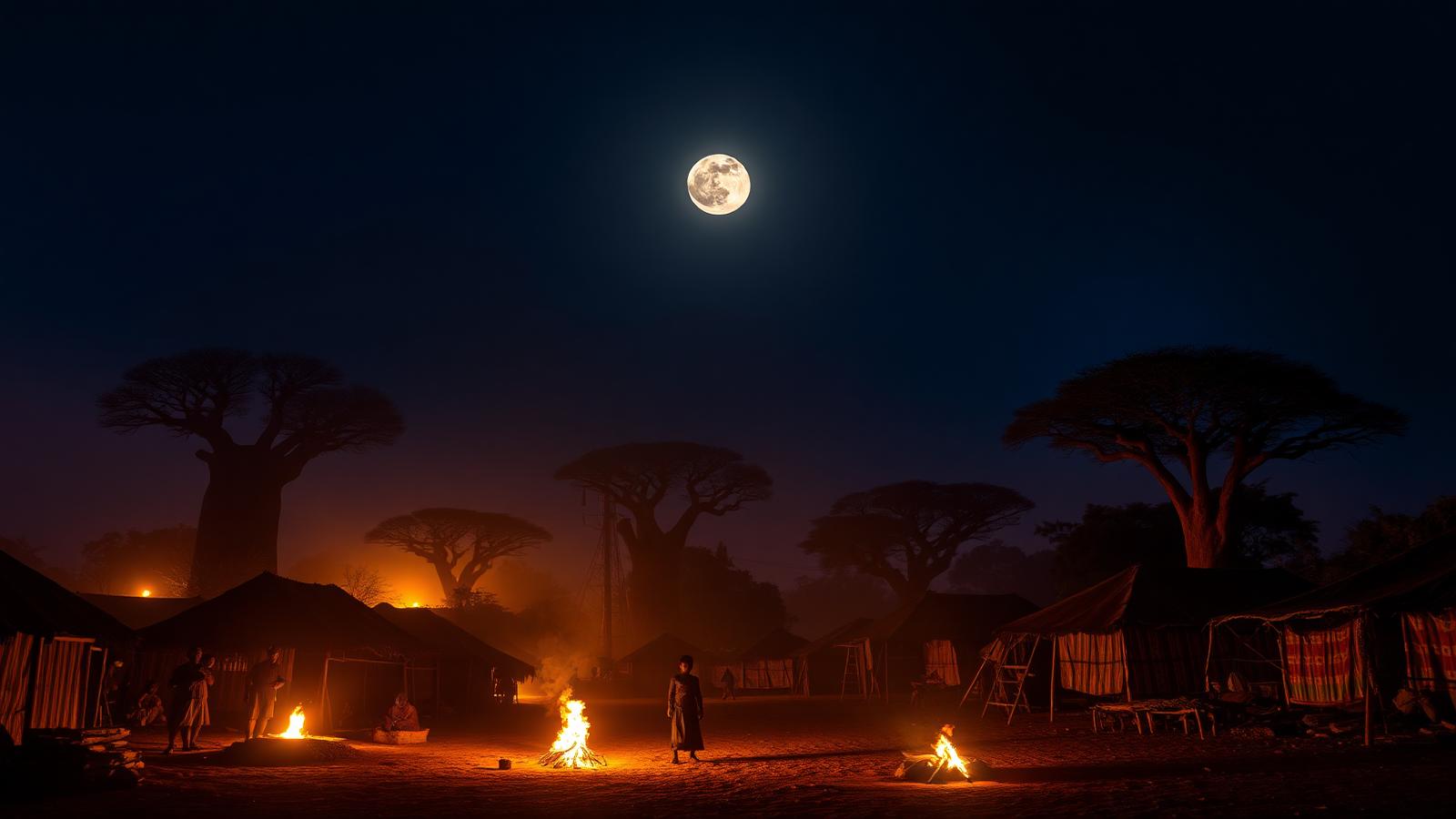
The Moonlight Story
Long ago, when the world was still new and animals spoke as freely as people do now, Anansi the spider decided that he alone should be the wisest creature who had ever lived. He did not want to share wisdom with the deer, or the tortoise, or the birds, or even with the humans he lived among. He wanted it all for himself, locked away where no one else could reach it.
So Anansi went from village to village, from forest to riverbank, collecting every piece of wisdom he could find. He gathered the wisdom of patience from the tortoise, who moves slowly but always arrives. He gathered the wisdom of caution from the antelope, who listens before it leaps. He gathered the wisdom of sharing from the weaver birds, who build their nests side by side. Piece by piece, story by story, saying by saying, Anansi poured all this wisdom into a great clay pot with a tight-fitting lid, until the pot was so full it could hold no more.
'Now,' Anansi said to himself, rubbing his eight hands together with delight, 'I alone in all the world will be wise. Every other creature will have to come to me, bowing, begging for a small taste of what I have collected. I will be richer than any king, for what is gold compared to wisdom?'
But Anansi was troubled by one thing: where could he hide such a precious pot where no one else would ever find it? He thought and thought, and finally decided that the safest place would be at the very top of the tallest silk-cotton tree in the forest, above the reach of every creature who walked on the ground.
So Anansi tied a long rope around the neck of the clay pot and bound the other end of the rope around his own belly, tying the heavy pot to the front of his body. Then he began to climb the great tree, meaning to hang the pot from the highest branch.
But the pot was enormous, and Anansi had tied it to his front, so that every time he reached for a higher branch, the pot swung against his legs and knocked his grip loose. He would climb a little, slip, climb a little more, slip again, all the while growing hotter and more frustrated in the midday sun. He tried gripping the tree with his knees. He tried tucking the pot under one arm. He tried wrapping his legs around the trunk while balancing the pot on his head. Nothing worked, and still the pot swung stubbornly in his way, banging his shins and scraping the bark.
As Anansi struggled, red-faced and sweating, a small boy named Kwaku happened to be walking through the forest on his way to fetch water for his mother. He stopped beneath the tree and watched Anansi's clumsy, furious climbing for a long while, tilting his head this way and that.
Finally the boy called up, 'Anansi, why don't you tie the pot to your back instead of your front? Then your arms and legs would be free to climb, and the pot would not be in your way at all.'
Anansi froze on the tree trunk. It was, of course, the obvious answer — so obvious that he felt a hot flush of shame spread through his whole body, worse than any bruise the pot had given him. Here he was, holder of all the wisdom in the world, and a small boy on his way to fetch water had just solved in one sentence what Anansi had been struggling with for the better part of an hour.
'How can this be?' Anansi cried out, half to the boy and half to himself. 'I have collected every piece of wisdom that exists in this world, sealed inside this very pot, and yet you, a mere child, have just shown me something I did not know!'
The boy shrugged, already turning back toward the path. 'Maybe your pot is not as full as you think, Anansi.'
That single sentence struck Anansi harder than any fall from the tree could have. He sat very still on the branch, the pot balanced now more easily on his back exactly as the boy had suggested, and thought about what it meant. If a child with no pot at all, no collection, no great hoard of sayings and stories, could still see something true that Anansi had missed — then wisdom could never truly be gathered up and finished. It would always keep growing in unexpected places, in unexpected people, long after anyone thought they had collected it all.
In his fury and his shame, Anansi did something he had never intended. He raised the pot high over his head and hurled it down from the tree. It struck a rock at the base of the trunk and shattered into a thousand pieces, and all the wisdom that Anansi had spent so long gathering scattered across the forest floor — into the grass, into the streams, into the wind, into the ears of every passing bird and creature and person who happened to be nearby that day.
That is why, the Akan elders say, wisdom is found scattered everywhere in the world today, a little in every person, a little in every place, rather than locked away in the keeping of any one creature, however clever he believes himself to be. And that is why, whenever someone tries to hoard all the answers for themselves, the Ashanti remind them gently of the day Anansi's pot broke on a stone beneath the silk-cotton tree.
Moral Lessons
What the Story Teaches
- For children
- No one knows everything, not even the cleverest spider — and sometimes the smallest child has the answer the grown-up missed.
- For adults
- Trying to hoard all the answers for yourself is exhausting and, in the end, impossible. True wisdom grows when it is shared, not sealed away.
- For leadership
- A leader who believes they alone hold all the answers will eventually be humbled by someone they never expected to teach them anything.
- For business
- Institutional knowledge locked in one person's head is a fragile business. Share it, document it, and let it strengthen the whole team.
- For family
- Parents and elders can learn as much from children's fresh eyes as children learn from tradition. Stay curious in both directions.
- For community
- A community thrives when knowledge circulates freely rather than being hoarded by the powerful or the proud.
Discussion Questions
For the Family or Classroom
- Why did Anansi want to keep all the wisdom in the world for himself?
- What does the boy's simple suggestion reveal about the limits of Anansi's plan?
- Why do you think Anansi broke the pot instead of simply accepting the boy's help quietly?
- What does it mean that wisdom scattered across the world instead of staying in one place?
- Have you ever learned something important from someone younger or less experienced than you?
- How might this story change the way a leader listens to junior voices on their team?
Related Proverbs
"Wisdom is like a baobab tree; no one individual can embrace it."
"Nnipa nyinaa ye Onyame mma; obiara nnye asase so ba."
"It is the little bird called Sankofa that reminds us it is not wrong to go back for what you forgot."
Characters
Anansi
The spider who hoards wisdom
Clever, proud, greedy, ultimately humbled
Symbolism: The danger of believing knowledge can belong to one person alone
Kwaku
The boy who solves Anansi's problem
Observant, plainspoken, unimpressed by status
Symbolism: The wisdom found in ordinary, overlooked people
Vocabulary
Anansesem
ah-NAHN-say-sem · Akan/Twi
Spider stories; the Akan term for the whole genre of Anansi folktales
Kwaku
KWA-koo · Akan
A traditional Akan day-name given to boys born on Wednesday
Silk-cotton tree
silk COT-un tree · West African folklore
A towering tree considered sacred in many West African traditions
Watch
Animated story film coming soon.
Listen
Narrated audio coming soon.
Music
McEncomium song adaptation coming soon.
Teacher Resources
For Classrooms and Homes
Download the full parable as a printable PDF — story, cultural background, moral lessons, discussion questions, proverbs, characters, and vocabulary, all in one handout for the classroom or family read-aloud.
Join the conversation
Village Square
Share your thoughts on this parable, ask questions, and connect with others exploring African stories and wisdom.
Village Voices
What villagers say about "Anansi and the Pot of Wisdom"
Loading comments…